
Blog
What Is Biryani? A Complete Beginner’s Guide to Pakistan’s Most Beloved Dish

There are dishes that feed you, and then there are dishes that move you. Biryani is the second kind.
If you have ever walked into a Pakistani restaurant and noticed every other table has a mound of fragrant, golden rice at its center, you have already witnessed the pull of biryani. If you have never tried it, you are standing at the edge of one of the greatest culinary experiences the world has to offer. And if you are already a fan, you know exactly why this dish commands the kind of loyalty that borders on devotion.
This is your complete beginner’s guide to biryani — what it is, where it came from, how it is made, what makes it so extraordinary, and how to order it like someone who truly understands it.
So, What Exactly Is Biryani?
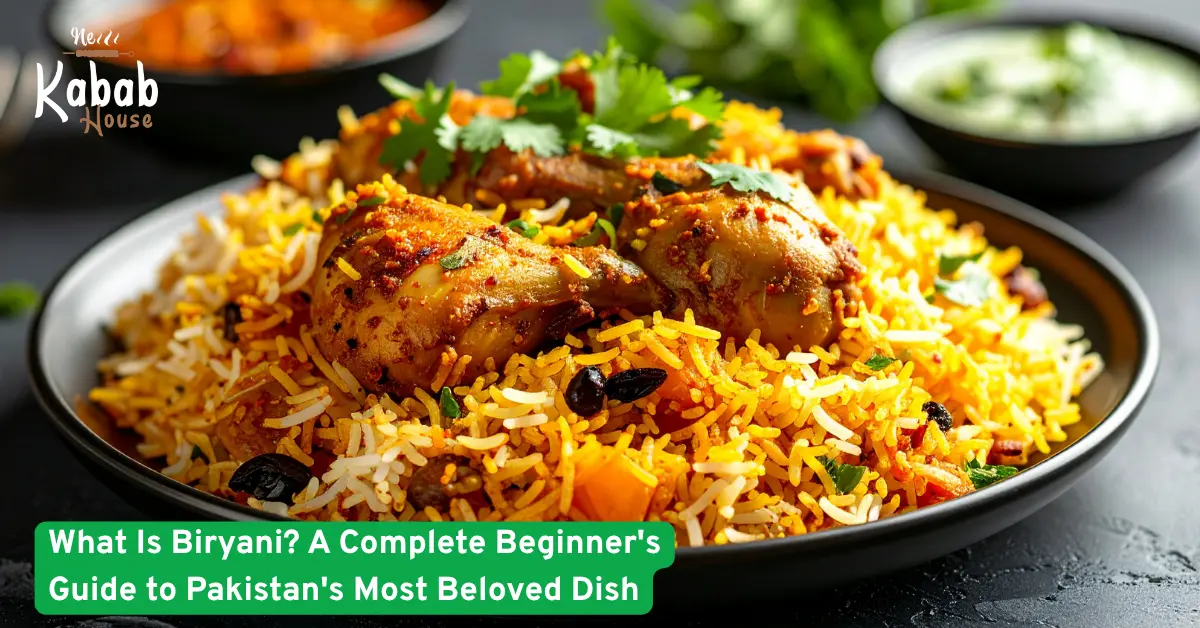
At its most basic, biryani is a layered rice dish made with long-grain basmati rice, marinated meat, and a complex blend of whole and ground spices, slow-cooked together until every grain of rice is perfumed with flavor.
But that description is like saying the ocean is a large body of water. Technically accurate. Completely insufficient.
Biryani is a dish of extraordinary depth. The rice is not just cooked — it is parboiled, then layered over slow-cooked, spice-marinated meat, then sealed and finished in a technique called dum cooking, where the pot is closed tightly and the dish steams in its own heat and moisture. The result is rice that is fluffy and separate, each grain carrying a different intensity of flavor depending on where it sits in the pot. The meat at the bottom is deeply spiced and tender. The rice at the top is light and fragrant. The layers in between are something you have to experience to understand.
It is also, it must be said, one of the most aromatic dishes in existence. The smell of biryani being cooked — whole spices blooming in hot oil, marinated meat releasing its juices, saffron steeping in warm milk before being drizzled over the rice — is enough to stop a conversation in its tracks.
A Brief History: Where Did Biryani Come From?
The origins of biryani are passionately debated, but most food historians trace its roots to Persia, where a dish called “birian” — meaning “fried before cooking” — was prepared by frying rice before cooking it with meat. Arab and Persian traders and travelers brought this technique to the Indian subcontinent, where it encountered an entirely different spice tradition and was transformed into something new.
The Mughal Empire, which ruled much of South Asia from the 16th to the 19th century, is credited with elevating biryani from a soldier’s meal into a royal dish. Mughal emperors maintained some of the most sophisticated kitchens in the world, employing hundreds of cooks and creating elaborate culinary traditions that blended Persian, Central Asian, and South Asian influences.
It was in these royal kitchens that biryani became what it is today — a dish of ceremony, celebration, and extraordinary refinement. Over the following centuries, as the Mughal Empire’s influence spread and eventually fragmented, biryani traveled with it, taking root in different regions and evolving into countless regional variations.
Today, biryani is claimed with fierce pride by communities across Pakistan, India, Bangladesh, and the South Asian diaspora worldwide. Each region has its own version, its own spice signature, its own method. But the soul of the dish remains the same everywhere: layered rice, marinated meat, and the patience to let the dum do its work.
How Is Biryani Made? The Process Explained
Making a great biryani is an act of patience and precision. It cannot be rushed. Here is how it comes together:
Step 1 — The Marinade Meat — most commonly chicken, lamb, or beef — is marinated for several hours in a mixture of yogurt, ginger-garlic paste, red chili, turmeric, garam masala, and fresh herbs. The yogurt tenderizes the meat and helps the spices penetrate deeply. This step is non-negotiable. A biryani is only as good as its marinade.
Step 2 — The Rice Long-grain basmati rice is soaked, then parboiled in heavily salted water with whole spices — bay leaves, cardamom pods, cloves, cinnamon sticks, and star anise. The rice is cooked only partway through at this stage, around 70 percent done. It will finish cooking in the pot with the meat.
Step 3 — The Base Onions are sliced thin and fried slowly in oil or ghee until they are deeply golden, sweet, and crispy. These caramelized onions — called birista — are one of biryani’s most important flavor elements. Some are stirred into the meat; others are reserved for garnishing.
Step 4 — The Layering The marinated meat, cooked partway in its own spices and juices, is spread at the bottom of a heavy pot. The parboiled rice is layered on top. Then come the garnishes — fried onions, fresh mint, fresh coriander, a drizzle of saffron steeped in warm milk, and sometimes a little rose water for fragrance.
Step 5 — The Dum The pot is sealed — traditionally with a ring of dough pressed around the lid to create a steam-tight seal — and placed over a very low flame. Sometimes hot coals are placed on top of the lid too, so the heat comes from both above and below. This is dum cooking, and it is where the magic happens. Over the next 30 to 45 minutes, the rice finishes cooking in the steam rising from the meat below, absorbing every drop of flavor in the process.
Step 6 — The Reveal When the seal is broken and the lid is lifted, a cloud of spiced steam escapes. The rice has turned golden from the saffron. The herbs are wilted and fragrant. The meat underneath is fall-off-the-bone tender. This moment — the unsealing of the dum pot — is one of the great theatrical moments in all of cooking.
The Major Types of Pakistani Biryani
Pakistan has several distinct regional biryani traditions, each with its own personality:
Karachi Biryani The most widely recognized style outside Pakistan, Karachi biryani is bold, richly spiced, and deeply flavorful. It typically includes potatoes alongside the meat — a beloved addition that soaks up the spiced gravy beautifully. The spice level is assertive, the color is deep amber, and the overall experience is intensely satisfying.
Lahori Biryani From Pakistan’s cultural capital, Lahori biryani tends to be slightly milder and more aromatic than its Karachi counterpart. It leans heavily on whole spices and yogurt, and the rice is often perfumed with kewra water alongside saffron. Richer and more subtly complex.
Sindhi Biryani Originating from the Sindh province, this version is characterized by its tangy, spicy profile. It often includes dried plums or sour prunes alongside the meat, which give the dish a distinctive sweet-sour dimension that sets it apart from all other styles.
Memoni Biryani A specialty of the Memon community of Pakistan, this is considered one of the spiciest and most intensely flavored biryani styles. It uses less food coloring than other versions, relying instead on the natural colors of its spices and ingredients.
Afghani Biryani Lighter in color and more delicately spiced, Afghani-influenced biryani uses a different spice palette with more emphasis on cardamom, raisins, and fried nuts. It is closer to a pulao in some respects but carries the layered soul of biryani.
Biryani vs Pulao — What Is the Difference?
This question comes up often, and it deserves a clear answer. Both are rice dishes. Both use spices. But they are fundamentally different in technique and result.
In pulao, the rice and meat are cooked together in one pot from the beginning, in a measured amount of spiced stock. The rice absorbs the stock and cooks through in a single process. The result is more uniform, more subtle, and lighter.
In biryani, the rice and meat are cooked separately, then layered together and finished using the dum method. The flavors are more complex, more intense, and more varied throughout the dish. Every spoonful is slightly different from the last depending on where it comes from in the pot.
Pulao is a weekday dinner. Biryani is a celebration.
What Is Biryani Served With?
A properly served biryani comes with accompaniments that complete the experience:
Raita — Cooling yogurt with cucumber, mint, and cumin. Essential for balancing the spice and richness of the rice.
Shorba — A light, spiced meat broth served on the side to add moisture if needed.
Salad — A simple sliced salad of onion, tomato, cucumber, and lemon to cut through the richness.
Chutney — Green mint and coriander chutney or tamarind chutney for brightness and contrast.
Salan — In some traditions, biryani is served with a thin curry on the side — particularly in Hyderabadi and some Pakistani styles.
At New Kabab House, our biryani is served with fresh raita and salad so the full experience is there from the first bite to the last.
Why Biryani Is More Than Just Food
In Pakistani culture, biryani is not an everyday meal — it is a statement. It is what you cook when someone important is coming to visit. It is the dish served at weddings, Eid celebrations, and family reunions. It is the meal that defines hospitality.
When a Pakistani host serves you biryani, they are telling you something. They are saying: you matter enough for us to spend hours in the kitchen. You are worth the effort. Welcome to our table.
That cultural weight — centuries of celebration and community baked into a single pot — is part of what makes biryani taste the way it does. You are not just eating rice. You are eating history.
Tips for Ordering Biryani for the First Time
If you are ordering biryani for the very first time, here is how to make the most of it:
Choose chicken biryani to start. It is the most accessible version, with a lighter flavor profile than lamb or beef. Once you love it — and you will — explore the other meats.
Ask for raita. Always. It is not optional. The cooling yogurt is part of the dish.
Do not rush. Biryani is meant to be eaten slowly, exploring each spoonful. Some bites will be intensely spiced. Others will be more delicate. Both are correct.
Try the crust. If you are lucky, the rice at the very bottom of the pot develops a slight golden crust from contact with the heat. This is called socarrat in Spanish paella — in biryani, it is equally prized. Ask your server if any is available.
Share it. Biryani is at its best when eaten with others. Order a large portion and pass it around.
FAQs
Q: Is biryani always spicy? Not necessarily. The spice level varies by style and restaurant. Karachi biryani tends to be bolder and spicier, while Lahori biryani is more aromatic and moderate. At New Kabab House, you can always request a milder preparation.
Q: What meat is used in biryani? The most common options are chicken, lamb, beef, and goat. Vegetable biryani — made without meat but with potatoes, carrots, and peas — is also widely available and genuinely delicious.
Q: Is biryani gluten-free? Traditional biryani made with rice, meat, yogurt, and spices is naturally gluten-free. However, always confirm with your restaurant that no flour-based thickeners or marinades containing gluten have been used.
Q: How is biryani different from fried rice? Very different. Fried rice is a stir-fry technique using pre-cooked rice. Biryani is a slow-cooked, layered dish using parboiled basmati rice finished via steam. The spice complexity, technique, and flavor depth are in completely different categories.
Q: Can biryani be reheated? Yes, and many people argue that biryani tastes even better the next day once the flavors have had time to develop further. Reheat gently with a small splash of water to prevent the rice from drying out.
Q: What makes Pakistani biryani different from Indian biryani? Pakistani biryani tends to use more oil, bolder spicing, and often includes potatoes. Indian styles vary enormously by region — Hyderabadi biryani is perhaps the closest relative to Pakistani styles, while other Indian versions like Lucknowi biryani are more delicate and perfumed.
Q: Does New Kabab House serve biryani? Absolutely. Our biryani is prepared using traditional techniques with long-grain basmati rice, properly marinated meat, and the full layering process that makes authentic biryani what it is. It is one of our most popular dishes.
Come Experience the Real Thing at New Kabab House
Reading about biryani is a pleasure. Eating it is something else entirely. The fragrance when the dish arrives at your table. The way the saffron-colored rice catches the light. The first spoonful where the tender meat, the aromatic rice, and the cooling raita come together in your mouth simultaneously.
No description does it justice. You simply have to try it.
At New Kabab House in Windsor, Connecticut, we make biryani the way it has always been made — with time, care, quality ingredients, and deep respect for a dish that has been feeding and delighting people for centuries.
📍 Visit us: 384 Windsor Ave, Windsor, CT 06095 📞 Call us: (860) 904-2785 📧 Email: info@newkabab.com 🌐 View our full menu: newkabab.com/menu